
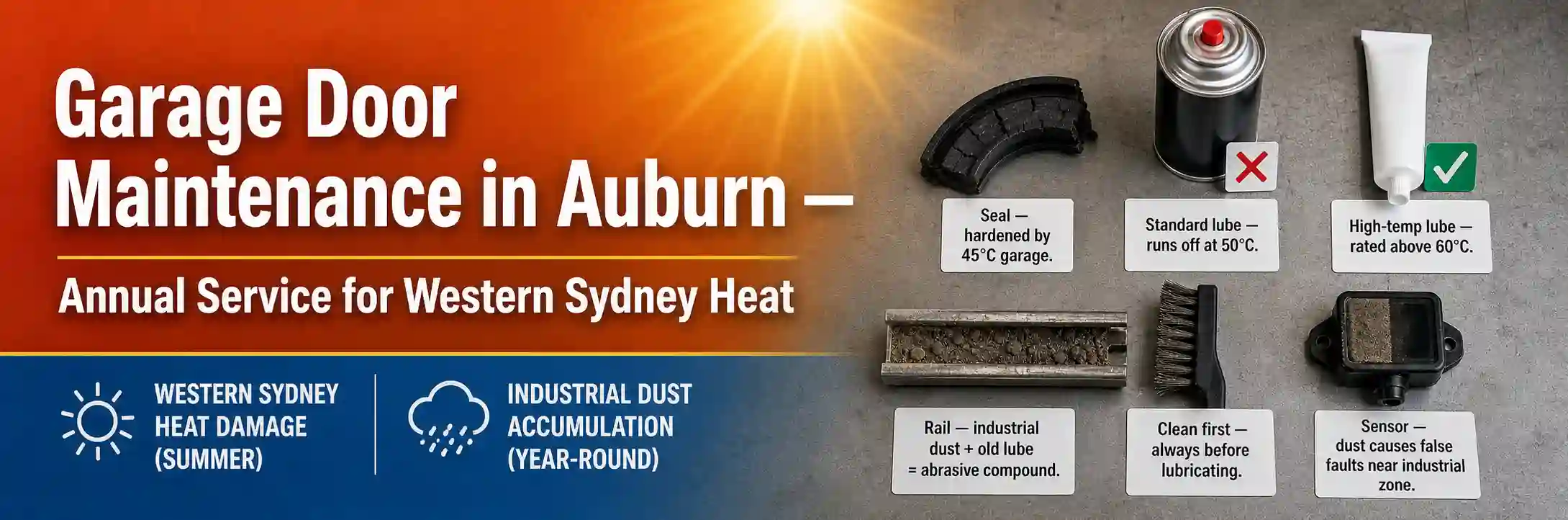
Garage door maintenance in Auburn NSW is shaped by two specific environmental dimensions that together distinguish this western Sydney suburb from both the temperate lower north shore and the extreme heat of Penrith further west. The first is western Sydney’s summer heat — Auburn’s 16-kilometre inland position from the coast means temperatures above 35 degrees Celsius are routine in January and February, without the coastal cooling that moderates Sydney’s eastern suburbs.
The second is the industrial dust dimension from the General Industrial zone that covers 16.07% of Auburn — manufacturing and warehousing operations that generate particulate matter settling in the guide rails and mechanisms of garage doors in adjacent residential streets. Garage door maintenance in Auburn combines the heat-aware lubricant and seal specification appropriate for western Sydney with the thorough guide rail cleaning priority that the industrial proximity creates for affected residential streets.
Western Sydney heat and Auburn garage door maintenance
Garage door maintenance in Auburn for western Sydney’s summer heat follows the same principle that applies in Penrith and Canning Vale — standard lubricants thin and run off metal surfaces at the temperatures inside a closed Auburn garage on a hot January afternoon. The inside of a closed Auburn garage facing afternoon sun in January reaches 45 to 55 degrees Celsius, depending on the door colour, the garage ceiling height, and the building’s orientation. At these temperatures, a lubricant specified for temperate conditions runs off spring coils and guide rail surfaces within weeks of the first summer heat wave.
The maintenance approach for Auburn garages:
- High-temperature lubricant for springs and guide rails — use a lubricant rated for the temperature range that Auburn’s garage interiors reach in summer. A product with a high-temperature rating — specifically stated to remain effective above 50 degrees Celsius — maintains adequate film thickness on spring coils and guide rail surfaces through Auburn’s summer rather than thinning to a runny film in the first heat wave.
- Pre-summer lubricant application in September-October — applying the high-temperature lubricant before the summer heat peaks begin ensures the spring and guide rail surfaces are protected before the first extreme heat event. A lubricant applied in September remains effective through January and February rather than one applied in April that has degraded by the time the summer peaks arrive.
- Motor thermal protection check — test the motor’s thermal protection function at the autumn maintenance visit and confirm the motor operates reliably in the ambient temperature of the garage in the afternoon. A motor that is already showing thermal protection activation in spring mild temperatures is one that will trip regularly in the summer heat.
Industrial dust dimension for Auburn maintenance
Garage door maintenance in Auburn for homes in streets adjacent to the General Industrial zone has the guide rail cleaning priority that industrial-adjacent suburbs across this guide series — Thomastown in Melbourne, Canning Vale in Perth — also require:
- Clean guide rails before lubricating — the industrial dust that settles in guide rail channels combines with existing lubricant to create an abrasive compound rather than a protective film. Cleaning the rail channels with a dry cloth or brush before any new lubricant is applied removes the abrasive compound. Applying lubricant on top of industrial dust traps the particulate in the rail and accelerates roller wear at the contact points.
- Increase cleaning frequency for most-exposed streets — for Auburn homes within one to two blocks of the industrial zone boundary, the guide rail cleaning frequency should be four-monthly rather than the standard twice-yearly for cleaner suburban environments. A more frequent cleaning cycle prevents the abrasive compound from accumulating to the level where it causes measurable roller wear between maintenance visits.
- Check sensor lenses for dust coating — industrial dust settles on sensor lens faces and accumulates to the point where it partially blocks the infrared beam, producing intermittent closure failures. Cleaning both sensor lenses with a dry cloth at every maintenance visit is a standard practice that is more important in Auburn’s industrial-adjacent streets than in cleaner suburban environments.
The Auburn maintenance calendar
Garage door maintenance in Auburn is structured around western Sydney’s season pattern:
September-October — pre-summer service: The most important single maintenance visit for an Auburn garage door. Apply high-temperature lubricant to springs, guide rails, roller wheel bearings, locking bars, and cable drums before the summer heat peaks begin. Test the motor thermal protection function. Replace any seals showing early deterioration before summer UV accelerates their failure. For industrial-adjacent streets, thoroughly clean guide rails before lubricating.
April-May — post-summer inspection: After summer, inspect springs for any rust or oxidation that developed during the summer months when standard lubricant may have thinned. Check cable end fittings for any corrosion that developed. Confirm the motor limit settings are still calibrated correctly after summer thermal cycling. Replace any bottom seals that hardened or cracked through summer UV.
The complete Auburn maintenance checklist
Garage door maintenance in Auburn covers all system components with western Sydney-specific attention:
- Spring inspection and balance test — inspect spring coils for surface oxidation that may indicate lubricant failure during summer heat. Perform the balance test to confirm the spring tension is still correct for the door weight. A door that is heavier than it was at the last service indicates a spring losing tension.
- Cable condition — inspect both cables from end fitting to end fitting. In Auburn’s relatively dry western Sydney climate, cable rust is less aggressive than in Brisbane’s subtropical humidity, but cables that have never been lubricated will still develop surface rust at the connection points over years of operation.
- Guide rail and roller service — clean guide rails (more thoroughly for industrial-adjacent streets), then lubricate with a dust-resistant product. Inspect each roller for flat spots or bearing wear. Replace worn rollers at the maintenance visit.
- Bottom seal and weatherstrip — inspect for cracking or hardening from western Sydney UV and heat. EPDM rubber seals maintain their flexibility longer than standard rubber in Auburn’s summer conditions.
- Motor and drive service — check drive chain or belt tension and condition. Test limit switch calibration. Test safety reversal function. Check remote control and receiver function from the full driveway range.
- Sensor cleaning — clean both sensor lenses with a dry cloth. For industrial-adjacent streets, check both lens faces for dust accumulation between maintenance visits.
Auburn’s dual occupancy properties and maintenance responsibility
Garage door maintenance in Auburn for dual occupancy properties — the granny flats, secondary dwellings, and dual occupancy constructions that are a significant part of Auburn’s residential stock — requires clarity about maintenance responsibility between the primary dwelling and the secondary dwelling’s garage door system. The specific maintenance responsibility framework for Auburn dual occupancy properties is addressed in the dual occupancy blog, but the practical maintenance point is that both garage door systems in a dual occupancy property require the same annual maintenance programme calibrated to western Sydney’s heat environment, even if they are maintained by different parties.
Auburn’s multicultural community includes a significant proportion of households where the property is a primary asset and where the investment in maintenance reflects the importance of the property to the household’s financial security. For these households — Turkish families who have owned their Auburn homes for a generation, Lebanese families who have renovated and extended their properties extensively, Chinese and Vietnamese families who have developed dual occupancy additions to maximise the property’s value — the garage door maintenance visit is part of the broader property care investment that protects an asset they have worked hard to own.
A maintenance provider who understands this investment context — who treats the garage door system with the same professionalism that a financial advisor treats the household’s savings — is one who earns the trust and the ongoing relationship that Auburn’s property-focused community values. The annual maintenance visit is not a transaction but the beginning of a multi-year service relationship that serves the household’s property investment as reliably as any other professional service they engage.
Conclusion
Garage door maintenance in Auburn NSW is calibrated to western Sydney’s summer heat and the industrial dust environment that affects the residential streets closest to Auburn’s General Industrial zone. High-temperature lubricant applied in September before the summer peaks, thorough guide rail cleaning before lubrication for industrial-adjacent streets, motor thermal protection testing, and post-summer spring and cable inspection in April or May are the specific maintenance actions that address Auburn’s environmental dimensions. A maintenance provider based in western Sydney who understands both the heat specification and the industrial dust cleaning priority delivers maintenance that genuinely extends the service life of garage door systems in one of western Sydney’s most vibrant and most active residential communities.